Current Position: HOME >> ABOUT >> Introduction
Edited by:赖丽伟Release Time:2026/11/14
Shenzhen Technology University (SZTU) is a public institution of higher education established by Guangdong Province and Shenzhen Municipality with a sound beginning and high standards. Officially approved by the Ministry of Education of the People's Republic of China in November 2018, the university admitted its first cohort of undergraduate, master's, and doctoral students in 2019 (with master's and doctoral programs initially offered in collaboration with Shenzhen University). The university is guided by the philosophy of "Innovation-Based, Demand-Driven, Open and Integrated, and Intelligence-Led Development". It closely aligns with national strategic needs and the industrial demands of Shenzhen and the Guangdong-Hong Kong-Macao Greater Bay Area, striving to build itself into a cradle for innovative engineers and entrepreneurs, as well as a source of industrial technological innovation in the Greater Bay Area.

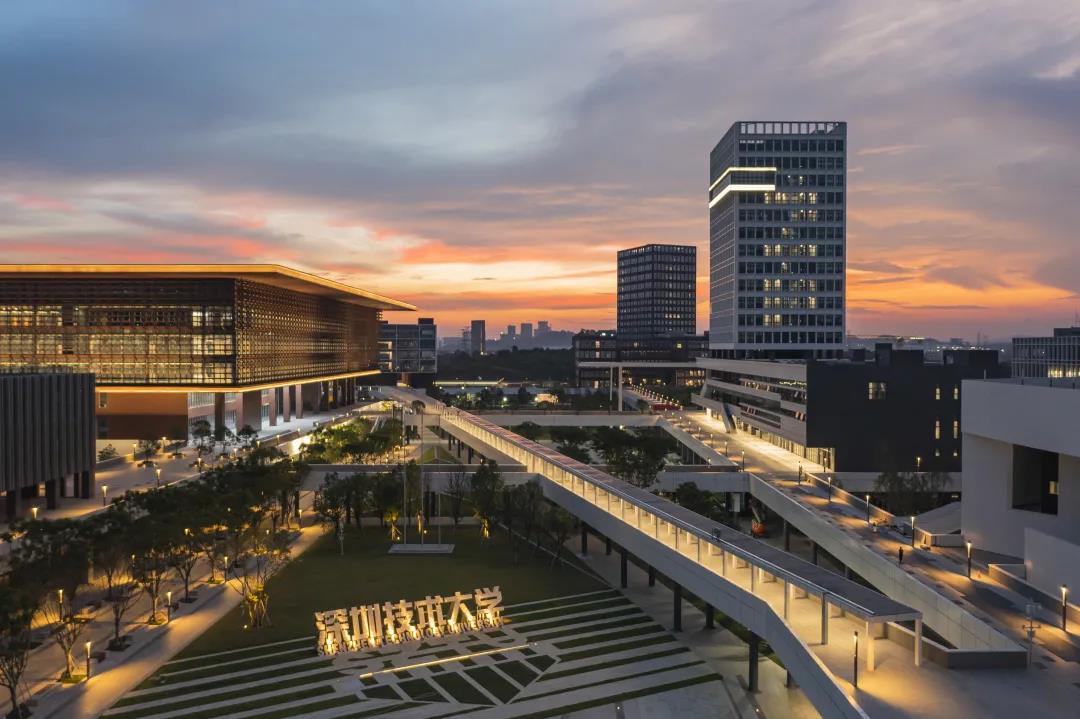
Shenzhen Technology University [Photo/Party Committee Publicity Department]
SZTU is located in Pingshan District, Shenzhen, with a total construction area of 1.05 million m². The university employs more than 940 full-time teachers, including four academicians, 126 professors and 238 associate professors. Over 400 faculty members are recognized as high-level talents at or above the municipal level. Among the full-time faculty, 86.3% hold doctoral degrees, nearly 60% have overseas study or research experience, and nearly 40% possess corporate R&D backgrounds.
With a focus on engineering, SZTU’s programs are embedded within Shenzhen’s “20+8” industrial clusters, aiming to promote the integrated development of AI across disciplines. The university currently comprises 18 colleges and schools, offering 41 undergraduate programs to students. Its three disciplines - Optical Engineering, Integrated Circuit Science and Engineering, and Internet of Things Engineering - have been selected as Guangdong Provincial Key Disciplines. It emphasizes the development of disciplines such as quantum technology, new energies and new materials, and artificial intelligence. Its three research fields - Chemistry, Materials Science and Engineering - have entered the top 1% globally in the ESI rankings, setting the record for the fastest ESI entry among universities in Shenzhen.
The university places strong emphasis on industry-education collaboration. It has forged in-depth partnerships with 279 leading enterprises and established six industry colleges, including the Shenzhen Semiconductor Advanced Manufacturing College, the SF Fengxue Industry College, and the BYD Future Mobility College. 25 elite classes have also been launched, such as the Huawei Kunpeng Elite Class, Tencent Security Talent Class, Baidu AI Elite Class, BYD Automotive Industrial Design Elite Class, and Loongson Zhongke Talent Class. It has supported teachers to found 126 enterprises, and established the first Technology Manager School in South China region.
The university highlights a “problem-oriented and demand-driven” approach, adheres to the principle of “application built on academic research, and academic research aimed at application”, and focuses on key industries such as new energy vehicles, integrated circuits, and biomedicine. It has built 1 proof-of-concept center and 3 pilot-testing bases, providing analytical testing services and technical support to more than 100 leading enterprises, including BYD, Huawei, and Snibe, and has undertaken 907 commissioned research projects. It has established 24 provincial and municipal-level research platforms and 70 university-enterprise joint laboratories, and is accelerating the construction of the Future Energy Storage Center and the Quantum Technology Center. It has achieved a series of important results in fields such as laser and additive manufacturing, new energy technologies and intelligent connected vehicle technologies, and advanced materials, and has won 39 provincial and municipal science and technology awards, including the First Prize of the Guangdong Provincial Science and Technology Progress Award.
Dedicated to internationalization and open development, SZTU actively promotes global collaboration. To date, the university has established partnerships with over 150 overseas universities and institutions, engaging in extensive international cooperation in faculty and student exchanges, joint training programs, and scientific research. It invites international professors and students from overseas universities to attend SZTU International Week every year and sends students to renowned overseas universities for exchanges regularly.


SZTU

SZTU International Cooperation and Exchanges Department

SZTU Admission Office