Researchers from Shenzhen Technology University (SZTU) have recently published a series of significant scientific achievements in high-impact international journals, demonstrating rapid progress in fields ranging from environmental engineering and energy catalysis to artificial intelligence and biomedical visualization.
1. Novel catalytic membrane for efficient wastewater purification
A team led by Prof. Chen Lingling from the College of Health and Environmental Engineering has developed a groundbreaking catalytic membrane for water decontamination. They created a vacancy-engineered single-atom MXene membrane (Co-N-Ti3−xC2Ty) that addresses the long-standing challenge of balancing high efficiency, large water flux, and stability in water treatment. The research results are published in Advanced Functional Materials, titled "Vacancy-Engineered Single-Atom MXene Membranes: A Quantum Leap in Ultrahigh-Flux Nanoconfinement Catalysis for Robust Water Decontamination."
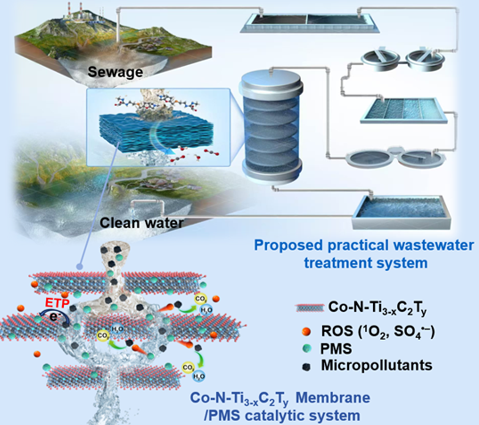
The schematic illustration of the proposed wastewater treatment system [Photo/https://doi.org/10.1002/adfm.202515784]
This membrane exhibits exceptional performance: a water flux of 2157 LMH (2-3 orders of magnitude higher than traditional membranes), significantly accelerates catalytic reaction kinetics (5-7 orders of magnitude faster), and maintains excellent stability during continuous operation for over 130 hours. It effectively degrades and mineralizes common organic micropollutants like carbamazepine and ofloxacin, with its byproducts showing no biotoxicity. The process is also cost-effective and energy-efficient, showing great promise for practical wastewater treatment applications.
2. Key breakthrough in understanding local chemical environment for electrocatalysis
Associate Prof. Yang Tao's team from Future Technology School, in collaboration with Southwest Jiaotong University, has made critical advances in electrocatalysis. Their research systematically elucidates the decisive role of the local chemical environment (the 1-10 nanometer thin region near the electrode surface) in reaction efficiency. The results have been published in ACS Catalysis.
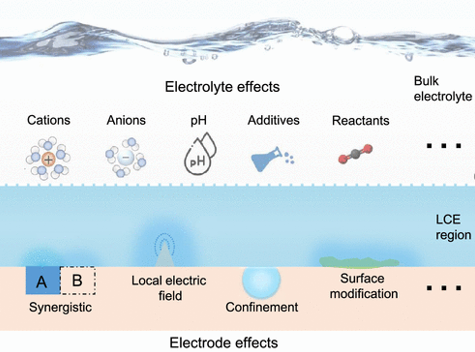
Diagrammatic sketch of the effects that influence the LCE [Photo/https://pubs.acs.org/doi/10.1021/acscatal.5c04489?ref=pdf]
Using advanced techniques like shell-isolated nanoparticle-enhanced Raman spectroscopy (SHINERS) and scanning electrochemical microscopy (SECM), the team successfully captured real-time dynamic changes of molecules during reactions. A key achievement was an "electrostatic attraction" strategy that created localized acidic micro-regions around platinum nanoparticles in an alkaline environment, boosting the reaction rate by tenfold. This work provides new fundamental insights for developing more efficient energy technologies.
3. AI-powered advancements in sleep stage classification and blood cell analysis
The Medical Data Mining team, led by Associate Prof. Fan Xiaomao from the School of Artificial Intelligence, has made two major developments.
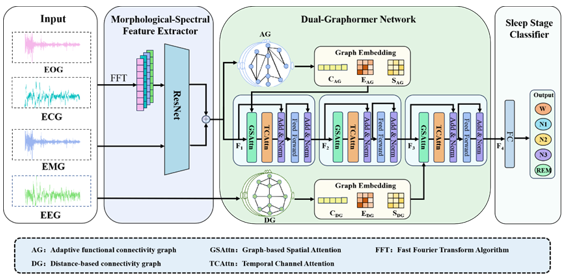
The network architecture of the proposed DGraphomer-SleepNet [Photo/https://www.sciencedirect.com/science/article/ abs/pii/S0957417425018408]
The team developed DGraphormer-SleepNet, a novel deep learning model based on a Graphormer architecture. This model effectively captures the complex spatiotemporal dependencies in sleep physiological signals, achieving breakthrough accuracy in sleep stage classification on international benchmark datasets (ISRUC-S1/S3). This technology holds significant value for improving the diagnosis and treatment of sleep disorders. The results have been published in Expert Systems with Applications.
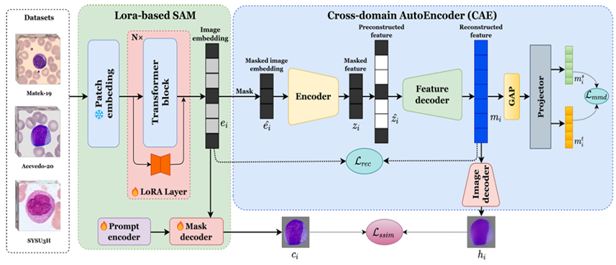
The DoRL architecture [Photo/https://doi.org/10.1016/j.patcog.2025.112000]
To address the performance degradation of AI models across different medical labs (domain shift), the team proposed DoRL, a novel framework leveraging the Segment Anything Model (SAM). DoRL uses low-rank adaptation (LoRA) to fine-tune SAM for cell segmentation and extracts domain-invariant features, significantly improving the generalization of blood cell classification models across diverse clinical datasets. The findings are published in Pattern Recognition.
4. Undergraduate team develops VR tool for protein visualization
A team of undergraduate students from the School of Artificial Intelligence, under the guidance of Dr. Wang Xin, has developed VisionMol, an innovative Virtual Reality (VR) application for protein molecular visualization and manipulation.
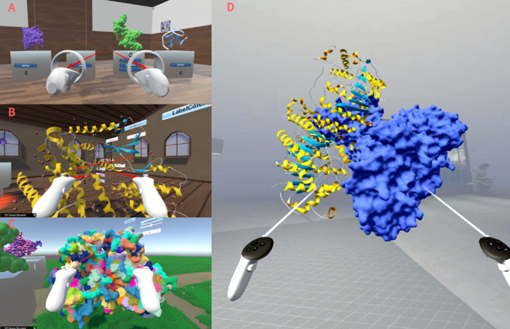
The illustration of VisionMol [Photo/https://doi.org/10.1093/bioinformatics/btaf118]
VisionMol allows researchers to immersively explore and interact with complex 3D protein structures, providing a more intuitive understanding compared to traditional 2D screen-based tools. It supports various protein data formats and offers customizable visualization options, facilitating deeper insights into protein function and aiding in areas like drug design. The team published their work in Bioinformatics.
The recent scientific achievements by SZTU researchers underscore its growing impact at the intersection of cutting-edge research and real-world applications. From pioneering catalytic membranes for sustainable water treatment and unraveling electrocatalytic mechanisms to advancing AI-driven medical diagnostics and immersive biomedical visualization tools, these breakthroughs reflect SZTU's commitment to innovation with practical relevance. As these technologies progress toward implementation, SZTU is poised to further strengthen its role as a hub for translational research, fostering sustainable development and technological advancement through science-driven solutions.
Drafted by Daisy(姚琦)/ International Cooperation and Exchanges Department
Revised by Brian(郑斌)/International Cooperation and Exchanges Department
Edited by Brian(郑斌)/ International Cooperation and Exchanges Department