Recently, the 2026 Breakthrough Prize in Fundamental Physics was announced. The three generations of the Muon anomalous magnetic moment (Muon g-2) experiment international collaborations from the European Organization for Nuclear Research (CERN), Brookhaven National Laboratory (BNL), and Fermi National Accelerator Laboratory (Fermilab) jointly received the award for their landmark contributions to particle physics.
Li Dikai, Assistant Professor at the College of Engineering Physics, Shenzhen Technology University (SZTU), is a core member of the Fermilab Muon g-2 International Collaboration and a co-recipient of the prize, sharing the award with 376 other researchers worldwide. This marks the first time a faculty member from SZTU has received this top international scientific award.
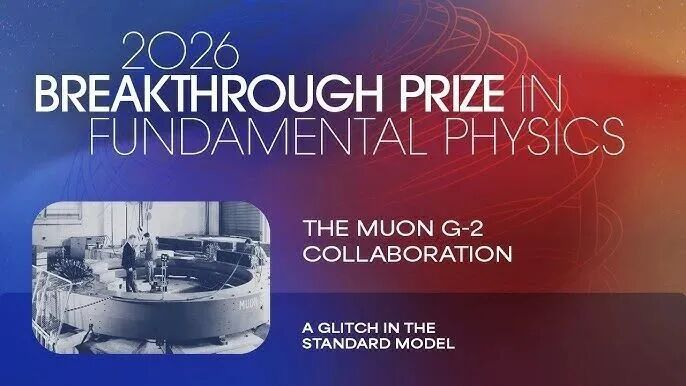
A poster for the 2026 Breakthrough Prize in Fundamental Physics awarded to the Muon g-2 Collaboration [Photo/https://breakthroughprize.org//]
Breakthrough Prize
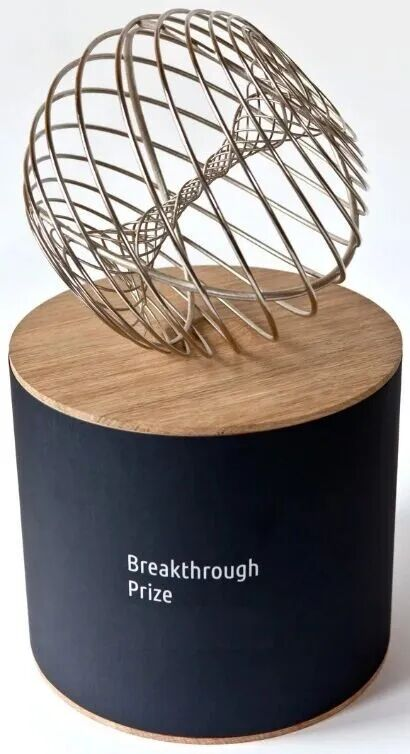
The Breakthrough Prize trophy[Photo/https://breakthroughprize.org//]
The Breakthrough Prize, established in 2012, is one of the world's most influential science awards. The Breakthrough Prize in Fundamental Physics is one of its three core awards, carrying a prize of $3 million. It aims to honor transformative and groundbreaking achievements in fundamental physics worldwide.The Muon g-2 experiment, which received this award, has been one of the most landmark precision measurements in particle physics over the past six decades. By achieving an ultra-high precision measurement of the Muon g-2, the experiment has opened new directions for testing the completeness of the Standard Model of particle physics and exploring new physics beyond it.The prize recognizes the pioneering work carried out by three generations of collaborations over several decades. Notably, the Fermilab collaboration pushed the experimental precision to 127 parts per billion (ppb), delivering the world's latest and most accurate results, and played a critical role in the award-winning achievement.

Li Dikai explains the core experimental equipment of the accelerator at the laboratory site. [Photo/College of Engineering Physics/]
Li Dikai joined the Muon g-2 Collaboration at Fermilab in 2016 as a postdoctoral researcher from Shanghai Jiao Tong University(SJTU). During his work with the collaboration, he took on key tasks including the reconstruction and analysis of the muon anomalous spin precession frequency, as well as offline data processing and analysis. He also served as a co-coordinator for the experiment’s database. The analysis results he contributed to were incorporated into the collaboration’s final combined measurement, providing important support for the breakthrough in experimental precision.
Li Dikai has long been engaged in experimental research at large international scientific facilities, gaining extensive experience. From 2010 to 2014, he joined the D0 international collaboration at the Tevatron accelerator at Fermilab, where he participated in the search for Higgs boson decay to bottom quark pairs and served as a co-coordinator of the jet tagging group. He built a solid research foundation and extensive experimental experience in physics simulation, particle detection, and reconstruction algorithm development, laying the groundwork for his subsequent precision measurements in muon physics.
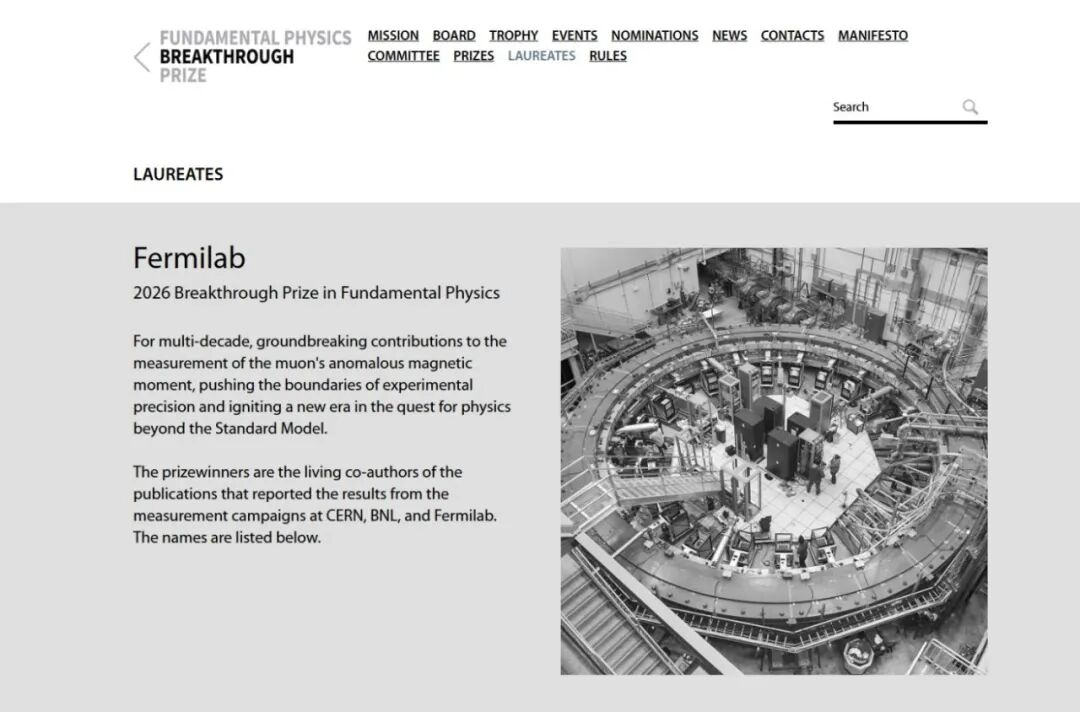

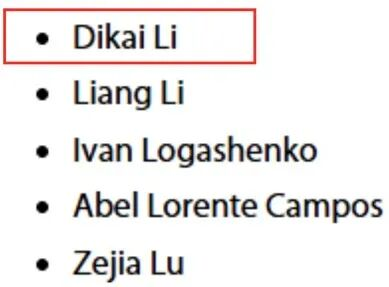
Li Dikai receives the 2026 Breakthrough Prize in Fundamental Physics for key contributions to Muon g-2 measurement[Photo/https://breakthroughprize.org/]
In June 2020, Li Dikai officially joined the College of Engineering Physics at SZTU while continuing his work with the Fermilab Muon g-2 international collaboration. He participated in offline data production during Runs 2-3 and data acquisition during Run 5, and continued analyzing spin phase and detector acceptance using Run 1-2 data. These efforts provided critical support for the collaboration's integration of multiple rounds of experimental data and in-depth analysis of systematic errors, contributing a solid experimental data foundation to the award-winning achievement.
While remaining engaged in cutting-edge international particle physics research, Li Dikai has been transforming the valuable experience gained at major international scientific facilities into a core driving force for the university's disciplinary development. As a core member of the university's ultrafast micro-focus X-ray diagnostic experiment team, under the guidance of team leader Professor Cao Leifeng, he has been actively promoting the construction of the accelerator and new X-ray source laboratory, undertaking responsibilities in laboratory construction and the installation and commissioning of a photocathode RF linear electron accelerator.
Li Dikai stated that he will continue to pursue in-depth research in accelerator physics and particle detection technology, contributing further to Shenzhen Technology University's goal of becoming a high-level applied research university.

Drafted by Lin Tongqi(林童淇)/ College of New Materials and New Energy
Revised by Olivia(赖丽伟)/ International Cooperation and Exchanges Department
Edited by Olivia(赖丽伟)/ International Cooperation and Exchanges Department