According to the latest ESI (Essential Science Indicators) data released by Clarivate on March 12, the Chemistry discipline of SZTU has ranked among the global top 1% of ESI for the first time, making a historic breakthrough. This research field becomes the third one at SZTU to join the ranks of world-class research field, following Materials Science and Engineering. It marks a new milestone in the university’s disciplinary construction and reflects its growing international influence.
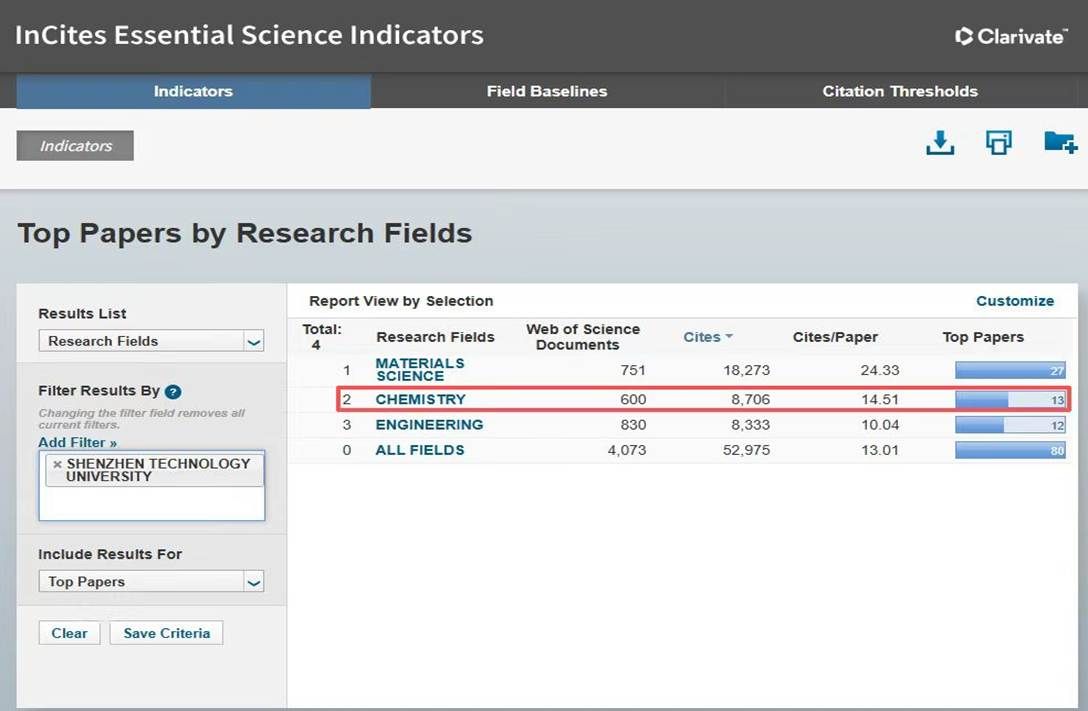
The Chemistry discipline of SZTU is included in the ESI Top Paper list [Photo/https://www.clarivate.com.cn]
SZTU aligns its disciplinary development with the regional industrial needs to cultivate advantageous disciplines. By focusing on interdisciplinary applied chemistry fields such as new energy, new materials and photoelectrocatalysis, the university has built university-enterprise collaborative research platforms and cultivated high-level applied research teams. SZTU continues to deepen the integration of disciplinary construction with industrial demands, and support the steady improvement of the discipline’s core competitiveness and international influence through applied research.
The statistical period adopted in the newly released ESI ranking data is 11 years, spanning from January 2015 to December 2025. According to the data, SZTU has published a total of 4073 SCIE/SSCI papers (Articles and Reviews), with 52975 total citations, including 80 highly cited and hot papers. There are 751 papers with 18,273 total citations in the field of Materials Science, including 27 highly cited and hot papers. In the field of Engineering, there are 830 papers with 8,333 total citations, including 12 highly cited and hot papers. For Chemistry discipline, there are 600 papers with 8,706 total citations, including 13 highly cited and hot papers.
Based on more than 12,000 journals and over 12 million articles indexed in the Web of Science (SCIE/SSCI), ESI provides statistics in research performance and rankings in research strength for countries, institutions, and journals across 22 research fields. As one of the world’s widely recognized evaluation tools, it is commonly used to assess the international academic level and influence of universities, research institutions, and countries/regions.
Drafted by Ke Limin(柯丽敏)/School of Foreign Languages
Revised by Olivia(赖丽伟)/ International Cooperation and Exchanges Department
Edited by Olivia(赖丽伟)/ International Cooperation and Exchanges Department